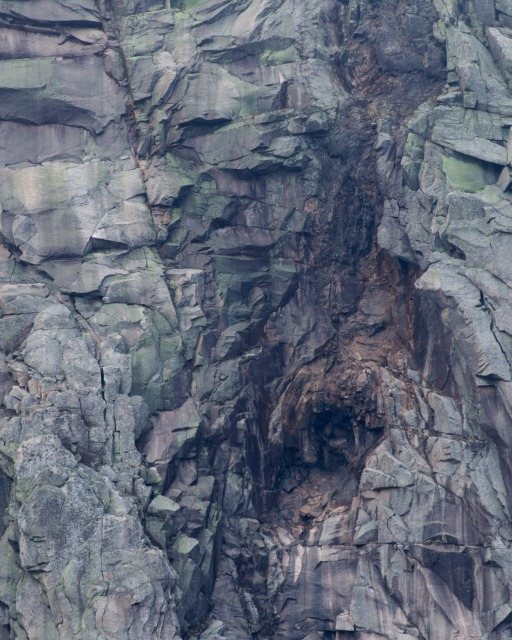
Letting the stone choose the line
Fault Line was not cut to length. It was split — driven apart along a bedding plane laid down in the stone roughly three hundred million years before anyone thought to sit on it. A row of feathers and wedges set into a line of drilled holes, tightened a quarter-turn at a time over most of a morning, until the block opened itself. Where a saw would have given us a flat face and a decision, the split gave us a surface that was already there and simply had not been seen yet.
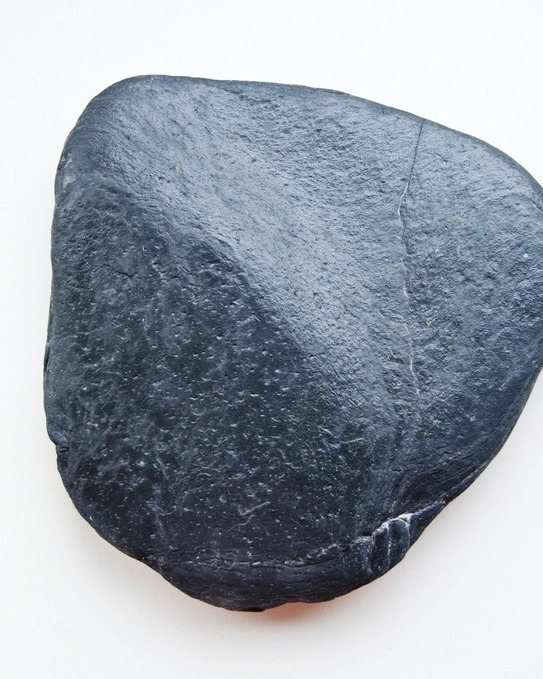
Two halves, one of which was wrong
A split produces two faces, and only one of them was any good. The block opened slightly off the plane we had read, leaving one half with a shallow step across its width that no amount of argument would remove. That half is still in the yard. We have never been able to decide whether it is a failure or the more honest of the two.
Dimensions & specification.
Fig. 01 — elevation dimensions, Fault Line. Not to architectural scale.
| Title | Fault Line |
| Year | 2021 |
| Material | Quarried limestone |
| Dimensions (H × W × D) | 2,400 × 460 × 440 mm |
| Weight | 1,090 kg |
| Edition | Unique |
| Catalogue no. | MN-021-06 |
| Status | Acquired — civic collection, London Borough of Havering |
On sitting on something older than sitting
The seat is left entirely unworked — no honing, no polish, no sealer. It is faintly dusty to the touch and will stay that way. Limestone takes a slow polish from use alone, and after five years in a public square the two places where people actually sit have begun, very quietly, to shine.
We did not make the surface. We only found out where it was.— Studio notebook, May 2021
In the room.
Enquire about
Fault Line.
This work has been acquired, but the studio can discuss a related commission.
Start an enquiry